Module 1-1: A Primer on AI
What is Artificial Intelligence?
AI is currently one of the biggest trends in the field of computer science. Artificial intelligence is a field of computer science dedicated to making computers act and think like humans do. It's difficult to make, but it could help us do a lot of cool things.
"AI," however, in a marketing sense, is a really vague term, because it means entirely different kinds of computing to various people. It's important for us to distinguish between different kinds of AI. Let's give a few examples.
Hardware
To some companies, "AI" is a catch-all term to use on products that use software to do something well. For example, an "AI Rice Cooker" won an iF Design Award in 2022, and uses sensors and motors to make the perfect rice for you. Although certainly cool, on a technical level this machine doesn't actually utilize AI at all. In fact, there are a lot of rice cookers on the market that market themselves as using "AI."

Machine Learning
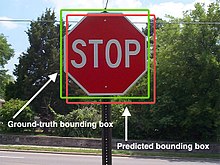
A more technical "AI" commonly used involves machine learning. Machine learning is a kind of program where a computer learns how to do something like a human would, by repeatedly practicing, failing at, and getting better at a particular task. Many of our software today relies on machine learning. One of the most common applications is for computers to be able to analyze a picture and determine things objects in a scene.
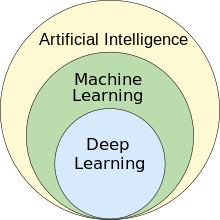
However, for this course, we're not interested in this kind of "AI" either. ChatGPT certainly uses machine learning (in fact, it's 100% machine learning) but we're interested in interacting with it, not making our own. To do so, we would need to have a master's degree in computer science. It should also be noted that machine learning is only a part of artificial intelligence, not all of it.
AGI
At its most technically complex, we have AGI. AGI, or Artificial General Intelligence, is a term used to describe a computer program that is so complex and intelligent that it has its own consciousness.
This is the kind of AI that movies and TV shows tend to highlight, in both good and bad ways. When taken positively, computers that have AGI are treated as real people, such as the superhero Vision in the Marvel Cinematic Universe.

But usually, the dominant way of writing AGI is to treat it as a threat to humanity. There are dozens of shows, games, and movies that go with this approach. One example is Skynet from the Terminator series, an AI system from the future that causes an apocalypse. The main plot of the first Terminator movie revolves around going back in time to prevent Skynet from happening.

We're obviously not going to teach AGI, because we haven't even reached it yet. Researchers hotly debate whether or not AGI is even possible. Some believe that an AI will never become sentient because all they know how to do is to talk like people, but not act like people. Of those that believe AGI is possible, they also debate whether or not AGI is a good or bad thing.
Large Language Models
As of 2024, tech companies are putting a huge push on integrating AI into every product they make. Most of the AI integrations are using what are called LLMs. LLMs, or Large Language Models, are computer programs that are trained on a colossal amount of data (as in, the entire internet), and are able to create outputs tailored to questions that resemble natural languages. In other words, they are programs that you can talk to.
ChatGPT is one of the biggest and most popular large language model on the market for consumers, and is the primary focus of our course. Other large language models also exist. Meta (the guys that own Facebook and Instagram) have a model named Llama, and Google has a model named Gemini. Generally, the features and use cases of these models are identical.